



Import Export Customs Service
What are import customs clearance and export customs declaration?
Import customs clearance refers to the procedures that must be handled in accordance with various laws, regulations, and rules when importing or exporting goods into or out of a country's customs territory. Customs clearance involves a series of processes such as inspection, declaration, examination, tax payment, and release. Goods cannot be received before customs clearance, and the consignee can only pick up the goods after the import customs clearance is completed.
Export declaration refers to the relevant procedures that need to be completed when exporting goods from China to foreign countries. This also involves a series of steps, such as: filling out export declaration forms, listing in detail the types, quantities, values, and other information of the exported goods; providing necessary supporting documents such as contracts, invoices, packing lists, etc.; paying export tariffs or obtaining rebates (depending on the specific situation); accepting customs inspections and approvals to ensure that the exported goods comply with the country's export policies and regulations; and finally, obtaining customs clearance to allow the goods to leave the country smoothly.


Documents required for customs clearance of imported goods
Commercial Invoice
Packing List
Bill of Lading
Sales Contract
Quality Certificate
Certificate of Origin
Sanitary Certificate
Phytosanitary Certificate
Import License
Other document
- Import and change pick up paper
- Pre-entry
- Declaration
- Tax payment
- Inspection and release
Import duties
Customs duties applicable for importations of goods are divided in several categories.
Customs Duties on most favored nations (MFN)
Conventional customs duties
Special Preferential customs duties
General customs duties
Quota customs duties (RQT)
Temporary cutoms duties
Customs duties on most favored nations (MFN)
MFN taxes (Most Favored Nation) are the most often followed customs duties.
Broadly speaking, it is widely less important than overall rate Applied on non – MFN countries. Products concerned by This taxes are :
Imported goods towards China from a WTO member country.
Goods from countries or Territories having ratified a bilateral trade agreement which stipulate the provisions of the application of MFN taxes with China.
Goods from China
Conventional Customs Duties
It is Applied on imported goods from countries or Territories having ratified a regional trade agreement which stipulates the provisions on customs duties with China.
Special preferential Customs Duties
It is Applied on imported goods from countries or Territories having ratified a trade agreement which stipulates the provisions of preferential laws with China.
In general, these tariffs are lower than MPF rates and conventional customs duties.
General customs duties
The general tax is enforced on imported goods from countries or Territories with any agreements and treaties or from unknown origin.
Quota customs duties
The tariff quota law submitted imported goods to a lower tariff rate. For imported goods which outreach quotas, there is a more significant tariff rate.
Temporary customs duties
In 2016, China have been adopted these temporary customs duties which are lower than MPN.
These 787 imported Products concerned by this tax are:
- Baby diapers (2%)
- Sun glasses (6%)
- Kaolinite (1%)
- Health care products (Skin cosmetics = 2%)
Since 1th June 2015, China decreased its customs tariffs for 14 types of goods.
This Measure has been put into practice due to the decision made by the Chinese government of changing its tax policy for encouraging and increasing the domestic consumption.
Here is the list of imported goods concerned by customs duties:
- Cosmetics 2 % instead of 5%
- Shoes 12% instead of 22%
- Products made from fur 10% instead of 23%
- Outside clothes: 8 to 10% instead of 17,5 to 24%
- Cashmere and hosiery items: 7% instead of 14%
- Baby diapers : 2% instead of 7,5%
Tips
When importing goods, the consignee or its agent shall fill in the import goods declaration form in the format specified by the customs within the time limit specified by the customs, attach relevant shipping and commercial documents, and provide approval documents for the import goods to declare to the customs. The main documents for customs declaration include:
- Customs declaration for imported goods.
- Goods and commercial documents that need to be inspected.
- Production license for importing Chinese goods.
- Inspection and quarantine certificate.
- Approval documents for imported goods.
- Customs declaration power of attorney.
Export customs declaration steps
Declaration
- The consignor of export goods shall, in accordance with the provisions of the export contract, prepare the export goods on time, according to quality and quantity, and then go through the procedures of chartering and booking with the transportation company, and prepare to go through the customs declaration procedures with the customs, or entrust a professional (agent) customs declaration company to handle the customs declaration procedures.
- For enterprises that need to entrust professional or agent customs declaration companies to go through the customs declaration procedures with the customs, before the goods are exported, they should go through the procedures of entrusting the professional customs declaration company or agent customs declaration company near the export port. The entrusted professional customs declaration company or agent customs declaration company should collect a formal customs declaration power of attorney from the entrusting unit, and the customs declaration power of attorney should be in the format required by the customs.
- Preparing the documents for customs declaration is the foundation for ensuring smooth customs clearance of export goods. Generally, the documents that should be prepared for customs declaration include: consignment note (i.e. unloading paper), invoice, trade contract, export collection verification form, and various certificates involved in customs supervision conditions.
The time limit for customs declaration refers to the time limit for the consignor or its agent to declare to the customs after the goods are shipped to the port. The time limit for customs declaration of export goods is 24 hours before loading. For goods that do not require tax collection and inspection, the customs clearance procedures should be completed within one day from the acceptance of the declaration.
Inspection
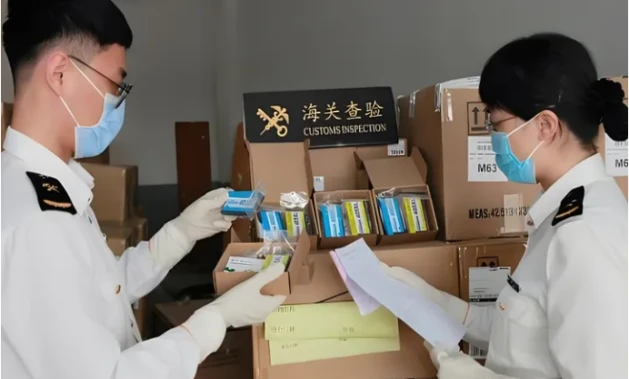
Inspection refers to a regulatory method in which the customs accepts the declaration of the customs declaration unit and has reviewed the declaration unit as a basis, and conducts actual verification of the exported goods to determine whether the content of the declaration documents matches the actual imported and exported goods.
- Verify the consistency between the declared content and the verified documents and goods in the declaration process by checking the actual goods and customs declaration documents. Through actual inspection, it is possible to discover whether there are any issues such as concealed reporting, false reporting, and false declaration that cannot be detected in the declaration and document review process.
- Through inspection, it is possible to verify the doubts raised in the declaration and document review process, providing a reliable regulatory basis for tax collection, statistics, and subsequent management. After inspecting the goods, a record of inspection must be filled out. The inspection record generally includes the inspection time, location, name of the consignee or agent of the imported and exported goods, the declared goods situation, the transportation packaging situation of the inspected goods (such as the name of the transportation vehicle, container number, size, and seal number), the name of the goods, specifications and models, etc. The goods that need to be inspected will be issued an inspection notice within one day from the time of receiving the declaration, and the inspection will be completed within one day from the time when the customs inspection conditions are met. In addition to paying taxes, customs clearance procedures should be completed within four hours after the inspection is completed.
Release
- For general export goods, after the consignor or its agent truthfully declares to the customs and pays the required taxes and related fees in full, the customs will stamp the "customs clearance seal" on the export loading document. The consignor of the export goods can ship the goods out of the country with the customs clearance document.
- Customs clearance for export goods: The consignor of the goods applying for customs clearance shall declare to the customs within three days from the date of customs clearance, and the goods can only be shipped out of the customs supervision area after being approved by the customs.
- Issuing export tax rebate declaration form: After customs clearance, the light yellow export tax rebate declaration form shall be stamped with the "inspection seal" and the signature of the person responsible for reviewing the export tax rebate that has been filed with the tax authority, and then returned to the customs declaration unit.
Tips
In China, about $150 million worth of goods are exported every day, and every day of delay in export verification and tax refund will cause great losses to our customers. How to speed up the export verification and tax refund process? The most important thing in document operation is to correctly fill out the export declaration form. The relevant content of the declaration form must be consistent with the manifest content transmitted by the shipping company to the customs in order to successfully verify and refund. After the customs accepts the declaration and releases it, due to reasons such as transportation equipment loading, some goods may not be loaded onto the original declared transportation equipment. The consignor of the export goods should promptly submit an "Application for Change of Export Goods Declaration Form" and corrected packing list invoice and bill of lading copy to the customs for correction. Only in this way can the content on the declaration form be consistent with that on the manifest.
Our Service
Provide a comprehensive solution for export customs declaration
01
Export Customs
Your supplier provides us with export customs declaration information, and we will assist you with the formal export customs declaration.
02
Buy Export License
If your supplier is unable to provide the necessary documents for customs clearance, we can help you buy export docs.
03
Multi-product name customs all-in service
If you have many suppliers and different product names, and they are unable to provide customs clearance information, we can help you!
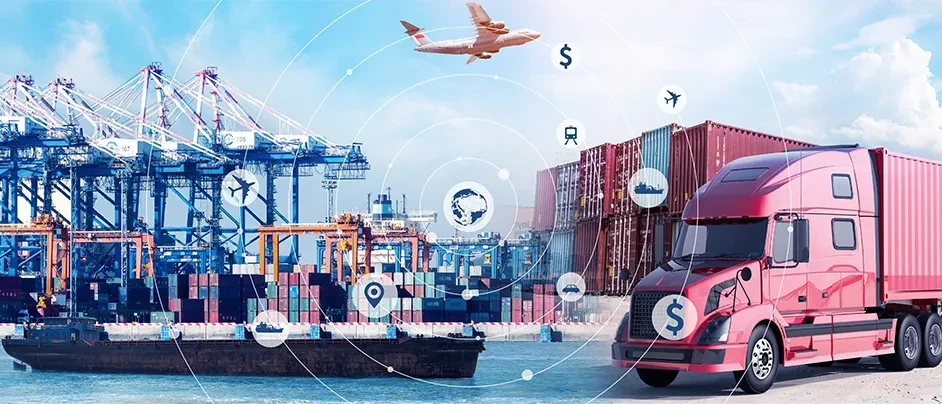

Professional team: Our customs brokers possess extensive experience and profound expertise in efficiently managing a diverse array of intricate customs clearance procedures.
Efficient service: We possess highly efficient information systems and logistics networks, which empower us to effectively carry out customs clearance procedures and expedite the shipment of goods.
Customer focus: We always put our customers first and tailor the most suitable logistics solutions for them.
Reliable guarantee: We have always acted in accordance with international and national laws and regulations to ensure the smooth transportation of our goods and unimpeded customs clearance.
Multi-Products export customs: We can provide buy license services for export customs, If you have multiple suppliers or different product names.

Q: 1. What is export customs clearance service?
Q: 2. Why do I need export customs clearance service?
Q: 3. What is the process of export customs clearance service?
Q: 4.How is customs duty calculated?
Q: 5.What happens if you don't pay customs?
Q: 6.What is the import duty in China?